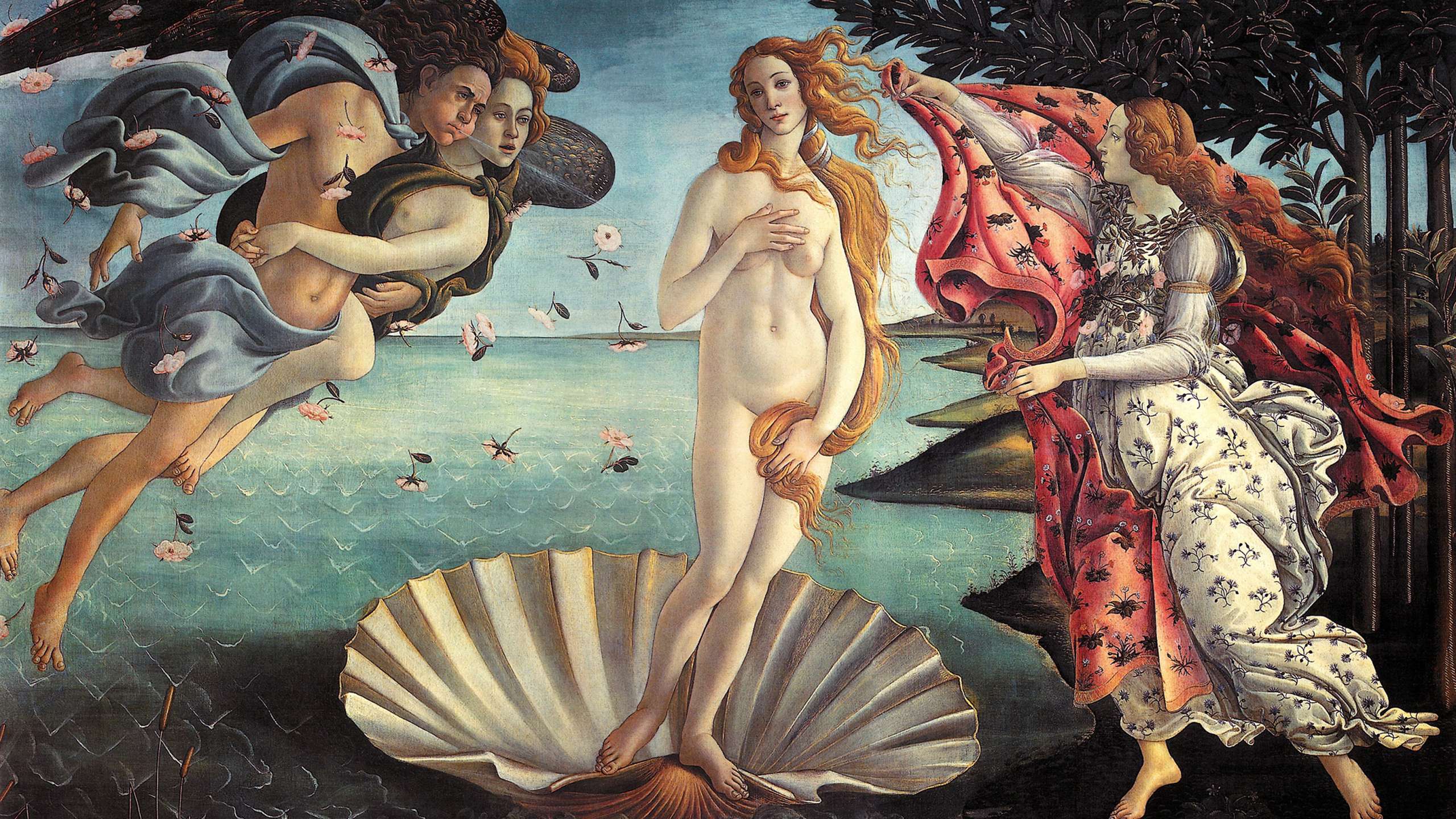

The Birth of Venus by Sandro Botticelli
“Without a shadow of doubt or a cloud of uncertainty, I’ve created enough diverse content to throw you off my scent. No footprints remain around the entrance of my cave. Neither the snake nor the dragon entered my lair; I live as one who has no worldly care.”
Here are few quotes and passages by Emil Cioran plucked from the tree of life while waiting to behold my starry night. However, you have to be an old man in the traditional sense in order to understand the nuance methinks. Cioran is like that archetypal philosopher that pops in and out of existence throughout the multiverse. A constant reminder that once we piss it all away, the earth gets fertilized, so don’t get lost in the stars, if you catch my drift:
—
I read him for the shipwrecked feeling I get from anything he writes. At first you follow, then you start going in circles, then you are caught up in a kind of mild unmenacing whirlpool, and you tell yourself you’re sinking, and then you do sink.
—
Anyone who gives himself up to writing believes—without realizing the fact—that his work will survive the years, the ages, time itself. . . . If he felt, while he was at work on it, that it was perishable, he would leave off where he was, he could never finish. Activity and credulity are correlative terms.
—
We must beware of whatever insights we have into ourselves. Our self knowledge annoys and paralyzes our daimon—this is where we should look for the reason Socrates wrote nothing.
—
We dread the future only when we are not sure we can kill ourselves when we want to.
—
If only I could reach the level of the man I would have liked to be! But some power, increasing year by year, draws me down. Even to get back up to my surface, I have to employ stratagems I cannot think of without blushing.
—
Uninterrupted freedom of expression exposes talent to a deadly danger, forces it beyond its means and keeps it from stockpiling sensations and experiences.
—
If we are the source of our ills, whom are we to confront? Ourselves? We manage, luckily, to forget that we are the guilty parties, and moreover existence is tolerable only if we daily renew this lie, this act of oblivion.
—
In some men, the prospect of a more or less imminent end excites energy, good or bad, and plunges them into a frenzy of activity. Artless enough to try to perpetuate themselves by their endeavor, by their work, they move heaven and earth to finish, to conclude it: not a moment to lose. The same perspective invites others to founder in what’s-the-use, in a stagnant clear-sightedness, in the unimpeachable truths of despond.
—
Look neither ahead nor behind, look into yourself, with neither fear nor regret. No one descends into himself so long as he remains a slave of the past or of the future.
—
“Do I look like someone who has something to do here on earth?” —That’s what I’d like to answer the busybodies who inquire into my activities.
—
Once I formulate a doubt, or more exactly, once I feel the need to formulate a doubt, I experience a curious, disturbing well-being. It would be far easier for me to live without a trace of belief than without a trace of doubt. Devasting doubt, nourishing doubt!
—
A free man is one who has discerned the inanity of all points of view; a liberated man is one who has drawn the consequences of such discernment.
—
What music appeals to in us it is difficult to know; what we do know is that music reaches a zone so deep that madness itself cannot penetrate there.
—
Years and years to waken from that sleep in which the others loll; then years and years to escape that awakening . . .
—
Think about those who haven’t long to live, who know that everything is over and done with, except the time in which the thought of their end unrolls. Deal with that time. Write for gladiators. . . .
—
All things considered, there have been more affirmations than negations—at least till now. So we may deny without remorse. Beliefs will always weigh more in the scales.
—
Why fear the nothing in store for us when it is no different from the nothing which preceded us: this argument of the Ancients against the fear of death is unacceptable as consolation. Before, we had the luck not to exist; now we exist, and it is this particle of existence, hence of misfortune, which dreads death. Particle is not the word, since each of us prefers himself to the universe, at any rate considers himself equal to it.
—
If you are doomed to devour yourself, nothing can keep you from it: a trifle will impel you as much as a tragedy. Resign yourself to erosion at all times: your fate wills it so.
—
In what we have agreed to call “civilization,” there resides, undeniably, a diabolic principle man has become conscious of too late, when it was no longer possible to remedy it.
—
Lucidity without the corrective of ambition leads to stagnation. It is essential that the one sustain the other, that the one combat the other without winning, for a work, for a life to be possible.
—
No autocrat wields a power comparable to that enjoyed by a poor devil planning to kill himself.
—
Everyone has had, at a given moment, an extraordinary experience which will be for him, because of the memory of it he preserves, the crucial obstacle to his inner metamorphosis.
—
When I torment myself a little too much for not working, I tell myself that I might just as well be dead and that then I would be working still less. . . .
—
In order to conquer panic or some tenacious anxiety, there is nothing like imagining your own burial. An effective method, readily available to all. In order not to have to resort to it too often in the course of a day, best to experience its benefit straight off, when you get up. Or else use it only at exceptional moments, like Pope Innocent IX, who, having commissioned a painting in which he was shown on his deathbed, glanced at it each time he had to make some important decision.
—
We are not afraid to accept the notion of an uninterrupted sleep; on the other hand an eternal awakening (immortality, if it were conceivable, would be just that) plunges us into dread. Unconsciousness is a country, a fatherland; consciousness, an exile.