

“The wise man will live as long as he ought, not as long as he can… He always reflects concerning the quality, and not the quantity, of his life.” — Lucius Annaeus Seneca
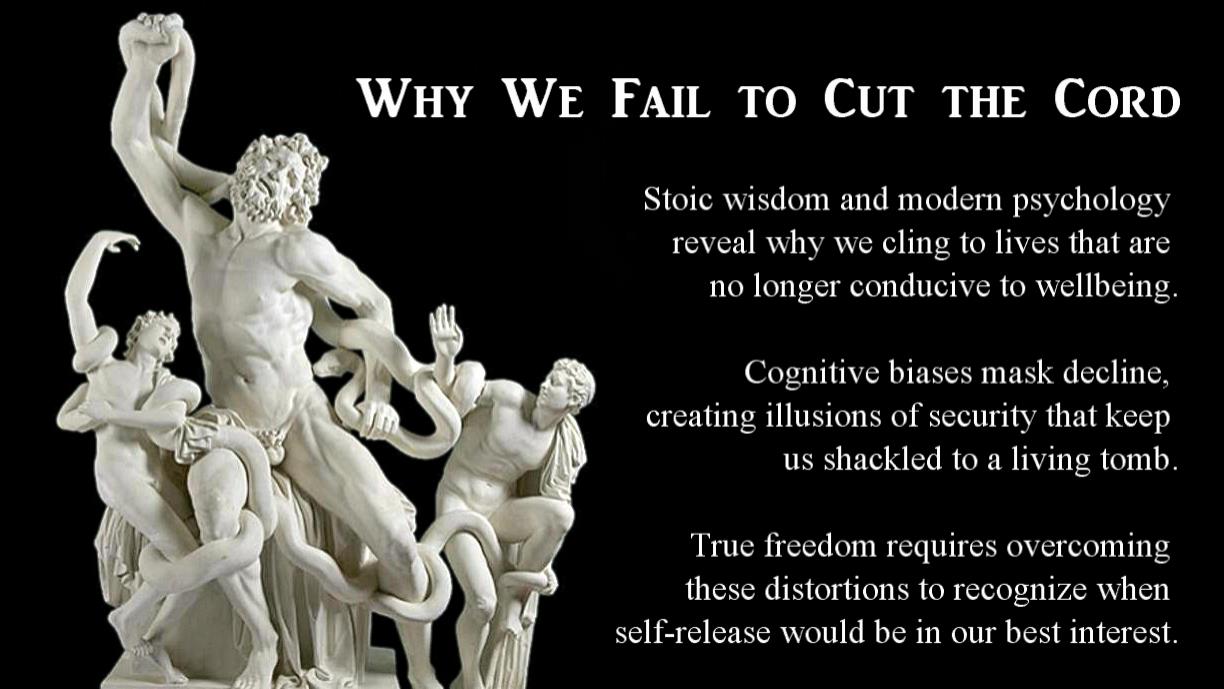
While Stoic philosophy invites us to confront mortality with clarity and equanimity, modern psychology helps explain why many people cling to lives or environments that no longer serve their well-being. Research suggests that individuals routinely overestimate the quality of their lives—not out of deliberate self-deception, but because perception itself is shaped by pervasive cognitive and emotional distortions.¹ These distortions tend to mask the awareness of decline, vulnerability, and loss, encouraging a reassuring narrative of stability and adequacy even when objective conditions suggest otherwise.² As a result, many remain unprepared for inevitable deterioration and hesitant to act decisively when circumstances demand serious reflection or meaningful change, including the difficult recognition that continued attachment may no longer be rational or dignified.
—
“It is one of the noblest functions of reason to know whether it is time to walk out of the world or not.” — Marcus Aurelius, Meditations III.1
—
This essay continues our earlier exploration of Seneca’s guidance on facing mortality and living freely. Whereas the previous discussion focused on the philosophical tools that prepare us for the certainty of death, the present analysis examines why so many fail to acknowledge the reality of their situation and fail to exercise their freedom to let go even when their life context calls for it. Cognitive and emotional biases—often invisible even to the most reflective minds—distort perception, creating a comforting illusion of security that may no longer be warranted or justified. By understanding these mechanisms, we see why Stoic discipline is essential: it trains the mind to perceive life clearly, recognize attachments, and act by reason rather than habit, impulse, or self-deception.
—
Why Life Often Appears Better Than It Is
—
Understanding this overestimation requires examining the underlying psychological mechanisms. Individuals are not intentionally self-deceptive; rather, their perceptions are shaped by automatic cognitive and emotional processes. Optimism bias, psychological adaptation, and social comparison collectively foster a perception that life is better than objective conditions would otherwise suggest.³ These mechanisms subtly influence attention, memory, and judgment, generating a sense of satisfaction that may obscure genuine challenges or decline. Recognizing these biases parallels the Stoic practice of examining impressions, enabling a productive synthesis of philosophical insight and empirical understanding in the pursuit of clarity and equanimity.
—
Optimism Bias: Seeing Life Through Rosy Glasses
—
A primary factor is the Pollyanna principle, also known as optimism bias. Individuals tend to focus predominantly on positive information and memories while minimizing, forgetting, or reinterpreting negative experiences. Recent research on high-stakes global crises confirms that this bias remains a pervasive barrier to risk assessment: individuals consistently underestimate their personal vulnerability to adverse events, even when objective data indicates high risk.⁴ When evaluating overall life satisfaction, individuals rely on this biased recollection. Positive experiences disproportionately shape judgment, even when negative events are frequent, thereby inflating perceived well-being and creating a narrative of hope and resilience—sometimes at the expense of realism.⁵
—
Psychological Adaptation: Adjusting to the New Normal
—
Humans adapt to changing events over time through a process known as psychological or hedonic adaptation. Following significant setbacks such as illness, job loss, or declining living conditions, initial distress diminishes as individuals adjust their expectations of normalcy. Similarly, positive changes, such as promotions or financial gains, yield only temporary increases in happiness.⁶ Although adaptation contributes to emotional stability, it can obscure gradual attrition in well-being. As circumstances deteriorate slowly, individuals may continue to perceive their lives as satisfactory despite an objective decline.⁷ Stoic philosophy addresses this by encouraging continual reflection on the impermanence of external goods, emphasizing that well-being is rooted in reasoned judgment and virtue rather than volatile external conditions.
—
Social Comparison: Measuring Life Against Others
—
Individuals often evaluate their well-being in relation to others rather than by absolute standards. Comparisons with those perceived as less fortunate can increase satisfaction, while comparisons with more successful peers may lead to dissatisfaction, even when objective conditions are wholly adequate. Social comparisons are typically selective and shaped by factors such as visibility, media exposure, and social context. Because individuals seldom compare themselves to a representative group, these comparisons introduce systematic distortions into self-assessment.⁸ According to Stoic philosophy, reliance on external measures impedes freedom; genuine contentment is achieved by aligning desires with nature and reason, rather than with fluctuating social conditions.
—
The Combined Effect
—
Optimism bias, adaptation, and social comparison collectively foster a strong tendency to overestimate life quality. These processes operate automatically across domains such as health, finances, relationships, and work, making overestimation a common rather than an exceptional phenomenon.⁹ Emotionally salient positive experiences often overshadow abstract or gradually developing objective indicators, which are less perceptible in daily life. Recognizing these biases is essential for self-knowledge and for living in accordance with reason, as Stoic philosophy advocates. Integrating empirical findings with philosophical practice provides effective tools for navigating life realistically while preserving inner freedom.
—
Conclusion: Awareness as Freedom
—
Illuminating the cognitive and emotional biases that inflate perceptions of life quality reveals a fundamental barrier to wise living: the resistance to confronting reality. Optimism, adaptation, and selective social comparison protect individuals from discomfort but may foster a false sense of security, postponing critical reflection on essential matters. Stoic philosophy, when combined with an awareness of these biases, promotes clear perception, deliberate preparation, and action guided by reason rather than habit or emotion. In this context, recognizing the limits of life and discerning when detachment or self-release is appropriate constitutes an exercise of freedom, dignity, and authentic self-governance. “We must press on, not only because we are drawing closer to death at every moment, but because our grasp of affairs and ability to give them close attention will come to an end before we die.” – Marcus Aurelius, Meditations III.1


